Whether you’re hosting unexpected guests, embarking on a wilderness adventure, or simply seeking a versatile sleeping solution, an air mattress offers unparalleled convenience and flexibility. These portable beds have evolved significantly, moving far beyond the flimsy, leaky models of yesteryear to become durable and comfortable sleep systems. However, the secret to their performance and longevity often lies in one crucial factor: the material they are made from. As an expert who has spent over a decade researching, testing, and reviewing countless air mattresses, I’ve seen firsthand how the choice between materials like PVC and TPU can dramatically impact your experience.
Today, the market is primarily dominated by two materials: PVC (Polyvinyl Chloride) and TPU (Thermoplastic Polyurethane). Each boasts distinct characteristics, making the decision of which material is better a nuanced one that depends heavily on your specific needs and priorities. This comprehensive guide will explore the fundamental differences, advantages, and disadvantages of PVC and TPU air mattresses, helping you navigate the options to select the ideal inflatable bed that aligns with your lifestyle and budget. Let’s delve into the world of air mattress materials and discover which one truly stands out for comfort, durability, and overall value.
Air Mattress: A Comprehensive Guide
Air mattresses have become an indispensable item for many households and outdoor enthusiasts, offering a flexible sleeping arrangement that can be quickly deployed and stowed away. From serving as a temporary guest bed to providing a comfortable sleeping surface on camping trips, their utility is undeniable. The key to a satisfying experience, however, often comes down to understanding the core components that make these inflatable beds function effectively.
Why You Need an Air Mattress?
|
Our Picks for the Best Air Mattress in 2026
As an Amazon Associate I earn from qualifying purchases.
|
||
| Num | Product | Action |
|---|---|---|
| 1 | iDOO Queen Air Mattress with Built in Pump, 18 Raised Comfort Inflatable Blow up Mattress, Upgraded Four Chamber Portable Air Bed for Camping, Guests and Home, Colchon Inflable, 650 lbs Max |

|
| 2 | Air Mattress Queen with Built in Pump, Inflatable Mattress Blow Up Mattress 16 Raised Comfort,Upgraded Surface Portable Bed, Air Bed for Home, Guest, Camping, Colchone Inflable, 650 lbs |
|
| 3 | Intex Dura-Beam Deluxe Comfort-Plush Elevated: Fiber-Tech – Queen Size – Built-in Electric Pump – 18in Bed Height – 600lb Weight Capacity |
|
| 4 | Queen Air Mattress Full with Built in Pump for Camping 16" High Speed Inflatable Mattress Inflation Completed in 3 Minutes, Luxury Blow up Mattress Comfort Flocked Airbed for Guest,Home |
|
| 5 | Intex Twin Size Air Mattress, 18in Height, Built-in Pump, Dura-Beam Deluxe Comfort-Plush - Portable Inflatable Blow-up Bed for Camping, Travel, Guests |
|
| 6 | Queen Air Mattress with Built in Pump Luxurious Comfort Raised Inflatable Mattress Queen Airbed Blow Up Mattress for Home and Guests Air Bed 2 Mins Fast Inflate/Deflate 660 lbs Max |
|
| 7 | OhGeni Queen Air Mattress with Built in Pump, Inflatable Mattress Blow Up Mattress 18 Raised Comfort,Upgraded Surface Portable Bed, Air Bed for Home, Guest, Camping, Colchone Inflable, 650 lbs |
|
| 8 | Intex 64417ED 22in Queen Dura-Beam Comfort Plush High-Rise Inflatable Air Mattress with Built in Pump for Travel and Camping, 600lb Weight Capacity |
|
| 9 | JOYTUTUS 5.5-5.8Ft Truck Bed Air Mattress with Removable Tailgate Extension,Thickened Inflatable Full Size Short Truck Beds, with Air Pump&2 Pillows,Black |
|
| 10 | Intex Air Mattress, 64123ED Dura-Beam Plus Pillow Rest Fiber-Tech – Queen Size – Built-in Electric Pump – 16.5in Bed Height – 600lb Weight Capacity |
|
Air mattresses provide unparalleled convenience and flexibility, making them a practical addition to any home or travel kit. They are ideal for accommodating overnight guests, offering a comfortable and readily available sleeping solution without requiring a permanent bed. For outdoor enthusiasts, an air mattress transforms a rugged camping experience into a restful night under the stars, elevating comfort above a simple sleeping pad. Beyond casual use, many also turn to air mattresses for their portability, easily packing them for road trips, RV adventures, or moving into new homes. They offer a temporary yet comfortable solution for various situations, adapting to your spatial and sleeping needs with ease.
Understanding Air Mattress Materials: PVC vs. TPU
The material composition of an air mattress is arguably its most critical feature, influencing everything from its durability and comfort to its environmental footprint and cost. PVC and TPU represent the two primary choices, each with a unique profile.
PVC Air Mattresses: The Traditional Choice
Polyvinyl Chloride, commonly known as PVC, has historically been the go-to material for inflatable products, including air mattresses. Its widespread adoption is largely due to its advantageous cost-effectiveness and good physical properties, which make it accessible to a broad market. PVC air mattresses are characterized by their thick texture and excellent load-bearing capacity, providing a firm and stable sleeping surface. This material is highly resistant to abrasion and various chemicals, contributing to its reputation for durability in many applications. Furthermore, PVC is inherently waterproof and airtight, making it excellent for retaining air over extended periods, an essential quality for any inflatable bed. Its ease of processing also allows manufacturers to create diverse shapes and designs, catering to a wide range of product needs from basic guest beds to pool floats.
However, PVC comes with notable drawbacks. It is heavier compared to modern alternatives, which can be a disadvantage for products requiring high portability. Environmentally, PVC raises concerns because its production and disposal can release harmful substances, and it is generally more difficult to recycle, often becoming brittle over time. While it offers basic comfort, some users might find PVC mattresses feel firmer and less conforming to the body, resembling a plastic sheet rather than a traditional bed. This material may also emit a distinct “plastic smell” when new, which can be off-putting for some individuals.
TPU Air Mattresses: The Modern Alternative
Thermoplastic Polyurethane, or TPU, represents a newer generation of materials in the inflatable products industry, favored for its high-performance characteristics and environmental benefits. TPU air mattresses are lauded for their exceptional softness and elasticity, offering a more luxurious and body-conforming sleep experience that significantly reduces pressure points. This material is remarkably lightweight and compact when deflated, making it an ideal choice for backpackers, campers, and anyone who prioritizes portability and minimal storage space.
Beyond comfort and portability, TPU boasts superior durability, including high abrasion and puncture resistance, which allows it to withstand rougher use and frequent folding better than PVC. It maintains its flexibility across a broad range of temperatures, preventing the material from becoming brittle in cold conditions or overly soft in heat. A significant advantage of TPU is its environmental friendliness; it can be produced without chlorine and is generally easier to recycle, with fewer hazardous chemicals involved in its manufacturing process. TPU mattresses also typically lack the strong plastic odor often associated with PVC products, contributing to a more pleasant user experience from the outset. Despite these numerous benefits, TPU mattresses are usually more expensive due to the higher cost of the raw material and specialized manufacturing processes. While durable, precise repairs can sometimes be more challenging if the material is severely damaged by sharp objects.
Detailed Comparison: PVC vs. TPU Air Mattresses
When choosing between PVC and TPU, a deeper look into specific performance metrics reveals why one might be more suitable than the other for various applications.
Durability and Longevity
In terms of raw strength, PVC is known for its robust, thick texture and strong load-bearing capabilities, making it suitable for heavier weights and pressures, often seen in multi-person or long-term static setups. However, PVC can become brittle with prolonged exposure to UV light and extreme temperatures, which can shorten its lifespan and lead to leaks over time. TPU, on the other hand, excels in flexibility and elastic recovery. Its higher abrasion and puncture resistance mean it can endure frequent folding and rough surfaces without easily tearing. TPU maintains its structural integrity better over a wider temperature range, contributing to a longer service life, especially for items used in varied outdoor conditions. While strong, TPU can be more challenging to repair if a significant puncture occurs.
Weight and Portability
For those who value lightweight gear and ease of transport, TPU is the clear winner. TPU material is significantly lighter than PVC, often by 30% or more for comparable strength. This substantial weight reduction makes TPU air mattresses the preferred choice for backpacking, thru-hiking, and other activities where every ounce matters. When deflated, TPU mattresses also pack down to a much smaller size, easily fitting into a backpack or compact storage space, offering superior portability for adventurers and frequent travelers. PVC, being denser, results in a heavier and bulkier deflated mattress, making it less ideal for situations requiring high portability.
Comfort and Feel
Comfort is a highly subjective but crucial factor in air mattress selection. TPU’s inherent softness and elasticity allow it to conform more closely to the body’s contours, distributing weight evenly and minimizing pressure points. Users often describe the feel of a TPU mattress as more “natural” and less “plastic-like,” providing a sleeping experience akin to a traditional mattress. PVC mattresses tend to be firmer and less yielding, offering more basic support. While adequate for many, some individuals may find them less comfortable for extended use, perceiving a sensation of floating or sleeping on a rigid surface rather than being cradled.
Environmental Impact and Safety
The environmental footprint of a product is an increasingly important consideration for consumers. PVC production involves halogenated chemicals and can release harmful substances, posing environmental and health concerns, particularly during manufacturing and at the end of its life cycle. It is also generally harder to recycle. TPU stands out as a more environmentally friendly option. It can be manufactured without chlorine, and many formulations are recyclable, leading to a reduced environmental impact. Additionally, TPU mattresses are less likely to off-gas unpleasant chemical odors, contributing to better indoor air quality and a safer sleeping environment from a chemical exposure perspective.
Cost and Value
Price often plays a significant role in purchasing decisions. PVC air mattresses are typically more affordable, making them an attractive option for budget-conscious consumers or those needing an air mattress for occasional, temporary use. Their lower production cost translates to a more accessible retail price point, ideal for mass-market products. TPU mattresses, however, come with a higher price tag. This increased cost reflects the superior raw material, advanced manufacturing processes, and the enhanced benefits they offer in terms of durability, comfort, portability, and environmental sustainability. For many, the long-term value and improved user experience of a TPU mattress justify the initial higher investment.
Repairability
Both materials can be patched if punctured, but there are differences in the ease and effectiveness of repairs. PVC is generally easier to repair using standard vinyl repair kits, which often involve a patch and adhesive. The material’s rigidity allows for a strong bond that can effectively seal small holes. TPU, while highly durable and resistant to punctures, can be more challenging to repair once damaged. Its elastic nature and specific chemical composition often require specialized TPU repair kits or more precise patching techniques to ensure a lasting seal. A poorly executed repair on a TPU mattress might not hold as effectively as one on PVC, potentially leading to persistent slow leaks.
Choosing the Right Air Mattress Material for Your Needs
The decision between PVC and TPU ultimately boils down to a careful assessment of your priorities and how you intend to use the air mattress.
Consider Your Use Case
If your primary need is for a lightweight, highly portable mattress for activities like backpacking, camping in remote areas, or frequent travel, a TPU air mattress is likely your best bet. Its minimal weight and compact packed size make it an adventurer’s dream. For occasional guest use at home, car camping where weight is less of an issue, or providing a durable, cost-effective option for children, a PVC mattress offers sufficient performance and longevity.
Factor in Your Budget
Your budget will inevitably influence your decision. PVC mattresses are significantly more affordable upfront, making them an excellent choice if you’re working with a tighter budget or don’t foresee needing a high-performance, long-lasting solution. If you’re willing to invest more for superior comfort, durability, and environmental benefits, a TPU air mattress represents a worthwhile upgrade that could offer greater satisfaction and a longer lifespan, effectively paying for itself over time through reduced replacement frequency.
Prioritize Your Values
Consider what matters most to you in an air mattress. If maximum comfort, a natural feel, and conforming support are paramount, TPU will likely provide a more satisfying sleep experience. For environmentally conscious consumers, TPU’s greener profile, from production to recyclability, makes it the responsible choice. If sheer load-bearing capacity and a firmer sleep surface at a lower cost are your main concerns, and environmental factors are secondary, then PVC could be a perfectly adequate option.
So, Which Material Is Better?
There isn’t a universally “better” material; rather, there’s a better material for your specific needs. For high-performance applications, where portability, comfort, and environmental responsibility are key, TPU is generally the superior choice. Its elasticity, lighter weight, and eco-friendly attributes make it ideal for discerning users and outdoor enthusiasts. However, for budget-conscious buyers seeking a durable, affordable, and easy-to-maintain mattress for occasional use or less demanding scenarios, PVC remains a robust and reliable option. The true “best” air mattress is one that perfectly balances its material properties with your personal requirements, ensuring a comfortable and appropriate solution for wherever you choose to lay your head.
| Feature | PVC Air Mattresses | TPU Air Mattresses |
|---|---|---|
| Cost | Generally more affordable, budget-friendly | Higher initial cost, premium pricing |
| Weight | Heavier, bulkier when packed | Significantly lighter, more compact when packed |
| Comfort | Firmer feel, less conforming, can feel “plastic-like” | Softer, more elastic, conforms to body, natural feel |
| Durability | Good load-bearing, abrasion-resistant, can become brittle with UV/heat | High elasticity, superior puncture/abrasion resistance, maintains flexibility across temperatures |
| Environmental Impact | Less eco-friendly, involves harmful chemicals, harder to recycle | More eco-friendly, chlorine-free, often recyclable |
| Portability | Lower portability, best for static or car-based use | High portability, ideal for backpacking and travel |
| Odor | May have a distinct “plastic smell” when new | Generally no strong plastic odor |
| Repairability | Easier to repair with standard vinyl kits | Can be more challenging, may require specialized kits |
| Ideal Use | Occasional guest bed, car camping, budget-conscious | Backpacking, high-end camping, frequent use, eco-conscious |
Mẹo Sử Dụng Và Bảo Quản Air Mattress
Proper care and maintenance can significantly extend the lifespan of any air mattress, regardless of its material. Always ensure you inflate your air mattress correctly; avoid over-inflating, as this can stress the seams and material, leading to premature leaks. Most mattresses come with recommended inflation levels, often indicating a firm but not rigid feel. When deflating, ensure all air is expelled before folding to prevent creasing and material fatigue.
Cleaning your air mattress is straightforward. For most spills or dirt, a damp cloth with mild soap is sufficient. Avoid harsh chemicals or abrasive cleaners that can degrade the material. After cleaning, ensure the mattress is completely dry before storing it to prevent mildew and material damage. Store your deflated and dry air mattress in a cool, dry place away from direct sunlight and extreme temperatures, which can cause both PVC and TPU to degrade over time. Keeping it in its original storage bag or a protective cover will also shield it from dust and potential punctures from sharp objects. Regularly inspecting for small leaks and patching them promptly can also prevent them from turning into larger, more complex repairs.
Các Lưu Ý An Toàn Khi Sử Dụng Air Mattress
While air mattresses are generally safe, a few precautions can enhance safety and prevent accidents. Always ensure the air mattress is placed on a flat, clear surface free of sharp objects, exposed nails, or debris that could puncture the material. Keep it away from heat sources like radiators, fireplaces, or open flames, as both PVC and TPU are susceptible to heat damage and melting. Avoid placing the mattress near electrical outlets or cords, especially if using an electric pump, to prevent tripping hazards or electrical shorts.
It’s crucial to supervise young children and pets around air mattresses. Small children can become trapped between the mattress and a wall or other furniture, posing a suffocation risk. Pets with sharp claws or teeth can also easily puncture the material. Ensure the mattress is inflated to a stable level to prevent rolling off, especially for children or individuals with mobility issues. Never use an air mattress as a flotation device unless it is explicitly designed and labeled for water use. Following these simple safety guidelines will help ensure a secure and enjoyable experience with your inflatable bed.
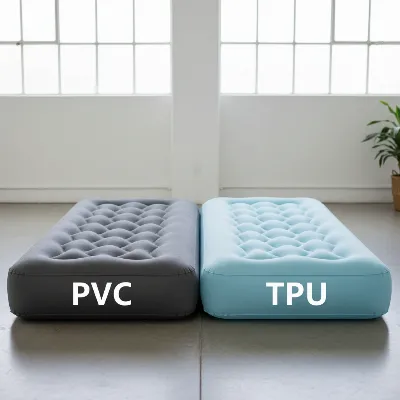 PVC and TPU air mattresses side-by-side highlighting their key differences in texture and appearance
Mua Air Mattress Ở Đâu?
Purchasing an air mattress is relatively easy, with options available both online and in physical stores. Each avenue offers distinct advantages.
Các cửa hàng bán Air Mattress uy tín:
Physical retail stores, such as department stores, sporting goods stores, and home goods stores, allow you to see and often feel the mattress before purchasing. This can be beneficial for assessing the material’s texture, firmness, and overall quality firsthand. Sales associates can also provide immediate answers to your questions and offer recommendations based on your needs. However, the selection might be more limited than online, and prices can sometimes be higher due to overhead costs.
Mua Air Mattress online: Ưu và nhược điểm:
Online retailers, including major e-commerce platforms and brand-specific websites, offer an expansive selection of air mattresses from various manufacturers, often at competitive prices. You can easily compare models, read customer reviews, and access detailed product specifications from the comfort of your home. The convenience of doorstep delivery is a significant advantage. The main drawback is the inability to physically inspect the mattress before purchase, relying instead on images and descriptions. However, many online stores offer generous return policies, mitigating this risk. For the widest selection and best value, online shopping often proves to be the most advantageous.
Conclusion
The choice between a PVC and TPU air mattress is more than just a material decision; it’s about aligning your sleeping solution with your lifestyle, budget, and values. PVC offers a cost-effective, durable, and readily available option ideal for casual home use or less demanding outdoor activities. It provides a firm sleep surface and stands as a reliable, no-frills choice for many. On the other hand, TPU represents an evolution in air mattress technology, delivering superior comfort, exceptional portability, enhanced durability, and a significantly smaller environmental footprint. While it comes at a higher price point, the long-term benefits in terms of user experience and ecological responsibility often justify the investment for frequent users, adventurers, and eco-conscious consumers.
Ultimately, understanding the unique strengths and weaknesses of each material empowers you to make an informed decision that ensures a restful night’s sleep wherever your adventures or guest needs take you. By considering your specific requirements—whether it’s the lightest pack weight for backpacking, the most comfortable guest bed, or a greener choice for the planet—you can select an air mattress material that truly serves your best interests. Which material will you choose to ensure your next inflatable sleep experience is the best it can be?
Câu Hỏi Thường Gặp
Are TPU air mattresses truly more eco-friendly than PVC?
Yes, TPU air mattresses are generally considered more eco-friendly. TPU can be produced without chlorine and involves fewer harmful chemicals in its manufacturing process compared to PVC. Furthermore, many TPU formulations are recyclable, reducing their environmental impact at the end of their lifespan, while PVC is harder to recycle and releases more toxins.
Can I repair a TPU air mattress if it gets a puncture?
Yes, TPU air mattresses can be repaired, although it can be slightly more challenging than repairing PVC. Specialized TPU repair kits are available and are recommended to ensure a strong, lasting seal. The elasticity of TPU requires precise application of patches and adhesives to maintain its integrity, preventing future leaks.
Why do PVC air mattresses often have a strong smell?
PVC air mattresses can emit a distinct “plastic smell” due to the volatile organic compounds (VOCs) released from the materials and adhesives used in their manufacturing process. This off-gassing is common with many plastic products and typically dissipates over time with aeration, though it can be a concern for individuals sensitive to chemical odors.
Is a TPU air mattress worth the higher cost?
For many users, a TPU air mattress is worth the higher cost due to its significant advantages in comfort, durability, and portability. Its lighter weight, compact packed size, superior elasticity for body conformity, and enhanced resistance to punctures and temperature changes often result in a more satisfying and longer-lasting product, especially for frequent travelers or outdoor enthusiasts.
Do PVC or TPU mattresses perform better in cold weather?
TPU mattresses generally perform better in cold weather conditions. TPU maintains its flexibility and elasticity across a wider temperature range, preventing it from becoming stiff or brittle. PVC, on the other hand, can become noticeably stiffer and less comfortable in freezing temperatures, potentially affecting its durability and overall performance in colder environments.
