Imagine settling in for a comfortable night, ready to relax on your air mattress, only to discover your electric pump is nowhere to be found, or perhaps it’s decided to take an unexpected vacation. A flat air mattress can quickly turn a peaceful evening into a frustrating dilemma, whether you’re hosting unexpected guests, embarking on a camping adventure, or simply dealing with a lost or broken pump. Fortunately, being prepared with alternative inflation methods can save your sleep and your sanity. This comprehensive guide will explore various safe and effective techniques to inflate your air mattress without a traditional pump, transforming you into a resourceful inflation expert.
Why You Might Need to Inflate an Air Mattress Without a Pump
Life often throws curveballs, and a missing or malfunctioning air pump is one of them. Understanding how to inflate your air mattress using everyday items is not just a party trick; it’s a practical skill that offers immense flexibility and preparedness. Unexpected overnight visitors can arrive, leaving you scrambling for an extra bed. For outdoor enthusiasts, a lightweight air mattress is essential for comfort, but a bulky pump might be impractical for backpacking. Even at home, a broken pump shouldn’t spell disaster for your temporary bedding. Knowing these alternative methods ensures you’re never caught off guard, providing a comfortable sleeping surface whenever and wherever you need it.
The Safest and Most Effective DIY Inflation Methods
When a dedicated pump isn’t an option, creativity and common household items can come to the rescue. Each method offers a unique balance of effort, speed, and accessibility.
The “Human Lung” Method (Breath Inflation)
This method is the most basic, requiring nothing but your own breath and a bit of stamina. It’s a true last resort but surprisingly effective for achieving a firm mattress if you have the patience.
- How to: First, ensure the air mattress valve is clean. Seal your mouth tightly around the open valve, take a deep breath, and exhale forcefully into the mattress. Once you’ve exhaled, quickly remove your mouth and close the valve to prevent air from escaping before taking another breath. Repeat this cycle, taking short breaks as needed, until the mattress reaches your desired firmness.
- Safety: The primary safety concern is lightheadedness or hyperventilation. Stop immediately if you feel dizzy or short of breath and take a break. Avoid overexertion. While your breath introduces some moisture, modern air mattresses are generally designed to handle this without significant long-term issues.
- Pros/Cons: It’s completely free and gives you precise control over firmness. However, it is labor-intensive, very slow, and can be quite tiring, especially for larger mattresses.
|
Our Picks for the Best Air Mattress in 2026
As an Amazon Associate I earn from qualifying purchases.
|
||
| Num | Product | Action |
|---|---|---|
| 1 | Intex Dura-Beam Deluxe Comfort-Plush Elevated: Fiber-Tech – Queen Size – Built-in Electric Pump – 18in Bed Height – 600lb Weight Capacity |

|
| 2 | Queen Air Mattress Full with Built in Pump for Camping 16" High Speed Inflatable Mattress Inflation Completed in 3 Minutes, Luxury Blow up Mattress Comfort Flocked Airbed for Guest,Home |
|
| 3 | Queen Air Mattress with Built in Pump Luxurious Comfort Raised Inflatable Mattress Queen Airbed Blow Up Mattress for Home and Guests Air Bed 2 Mins Fast Inflate/Deflate 660 lbs Max |
|
| 4 | Air Mattress Queen with Built in Pump, Inflatable Mattress Blow Up Mattress 16 Raised Comfort,Upgraded Surface Portable Bed, Air Bed for Home, Guest, Camping, Colchone Inflable, 650 lbs |
|
| 5 | OhGeni Queen Air Mattress with Built in Pump, Inflatable Mattress Blow Up Mattress 18 Raised Comfort,Upgraded Surface Portable Bed, Air Bed for Home, Guest, Camping, Colchone Inflable, 650 lbs |
|
| 6 | JOYTUTUS 5.5-5.8Ft Truck Bed Air Mattress with Removable Tailgate Extension,Thickened Inflatable Full Size Short Truck Beds, with Air Pump&2 Pillows,Black |
|
| 7 | iDOO Queen Air Mattress with Built in Pump, 18 Raised Comfort Inflatable Blow up Mattress, Upgraded Four Chamber Portable Air Bed for Camping, Guests and Home, Colchon Inflable, 650 lbs Max |
|
| 8 | Intex 64417ED 22in Queen Dura-Beam Comfort Plush High-Rise Inflatable Air Mattress with Built in Pump for Travel and Camping, 600lb Weight Capacity |
|
| 9 | Intex Air Mattress, 64123ED Dura-Beam Plus Pillow Rest Fiber-Tech – Queen Size – Built-in Electric Pump – 16.5in Bed Height – 600lb Weight Capacity |
|
| 10 | Intex Twin Size Air Mattress, 18in Height, Built-in Pump, Dura-Beam Deluxe Comfort-Plush - Portable Inflatable Blow-up Bed for Camping, Travel, Guests |
|
The Garbage Bag Technique
A common household trash bag can be ingeniously repurposed as a makeshift air pump, offering a more efficient alternative to breath inflation.
- How to: Grab a large, clean garbage bag. Open it wide and sweep it through the air to capture as much air as possible, much like a parachute catching wind. Quickly gather the opening of the bag, twisting it shut to trap the air inside. Bring the gathered opening to your air mattress valve, securing it tightly around the valve (you may need to cup your hands around it for a good seal). Then, press down on the bag to force the trapped air into the mattress. Release, refill the bag with air, and repeat the process until the mattress is firm.
- Safety: Use a clean bag to avoid transferring dirt or debris to your mattress. Ensure a snug fit around the valve to minimize air leakage, which can prolong the inflation process and lead to frustration.
- Pros/Cons: Garbage bags are readily available and cost-effective. This method is generally faster and less strenuous than manual breath inflation. However, it still requires repetition and might not achieve the rock-hard firmness of an electric pump.
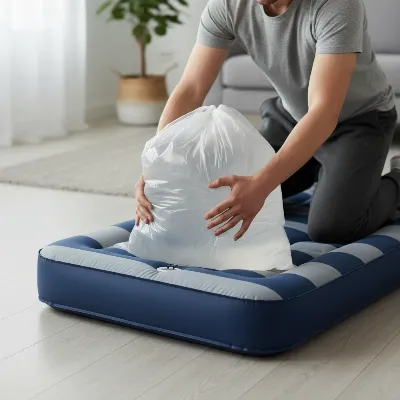 Person using a large garbage bag to inflate an air mattress manually
Hair Dryer (Cool Setting Only)
Your hair dryer, a staple in most bathrooms, can serve as an unexpected air pump, provided you use it correctly and cautiously.
- How to: Crucially, set your hair dryer to the COOL setting, or “cold shot” function, before you begin. Open the air mattress valve completely. Position the nozzle of the hair dryer as close as possible to the valve opening. If the fit isn’t perfect, cup your hands around the nozzle and valve to create a seal and direct the airflow. Turn the hair dryer on and let it fill the mattress.
- Safety: This is the most critical safety warning for this method: NEVER use hot air. Air mattresses are typically made of PVC or vinyl, materials that can melt, stretch, or deform when exposed to high heat, permanently damaging your mattress. Always confirm the cool setting is active. Ensure the hair dryer isn’t held so close that it might restrict airflow and overheat itself.
- Pros/Cons: This method is significantly faster than breath or bag inflation and utilizes a common household appliance. The main drawback is the absolute necessity of using only cool air, and it requires an electrical outlet.
Vacuum Cleaner (Blow Function)
Many modern vacuum cleaners, especially shop vacs, come equipped with a “blow” or exhaust function that can be incredibly effective for inflating an air mattress.
- How to: Locate the exhaust port or the “blow” setting on your vacuum cleaner. Attach the vacuum’s hose to this port. Select a nozzle that fits snugly into your air mattress valve – you might need to improvise with tape or a cloth for a tighter seal. Turn on the vacuum cleaner (ensuring it’s in blow mode, not suction) and let it work its magic.
- Safety: Always double-check that your vacuum is set to blow and not suction, as suction will quickly deflate your mattress. Ensure any attachments are secure to prevent them from flying off.
- Pros/Cons: This is often one of the fastest and most powerful methods, akin to using a dedicated electric pump. The main limitations are that not all vacuums have a blow function, and it requires electricity.
Bicycle Pump or Ball Pump
If you have a bicycle or sports equipment, a manual pump designed for tires or balls can often be adapted for an air mattress.
- How to: Identify the valve type on your air mattress. Many air mattresses have a Boston valve or similar, which might require a specific adapter that sometimes comes with the mattress or a general-purpose adapter kit. Once you have a fitting nozzle, insert it firmly into the mattress valve and begin pumping manually.
- Safety: Ensure the adapter fits securely to prevent air leakage and avoid straining the valve. Pumping with too much force or at an awkward angle can potentially damage the mattress valve.
- Pros/Cons: Offers good control over firmness and doesn’t require electricity. However, it can be physically tiring, especially for large mattresses, and you might need a specific adapter.
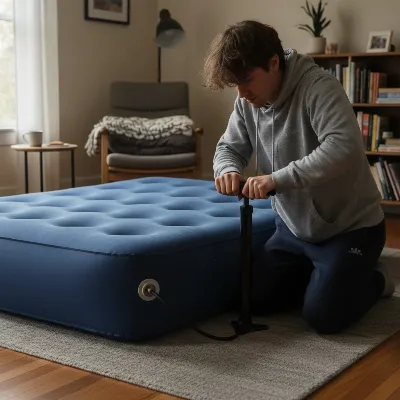 Person using a bicycle pump to inflate an air mattress in a living room
Using a Standard Fan
While less powerful than a hair dryer or vacuum, a simple household fan can contribute to inflation, albeit slowly.
- How to: Position a standard box fan or oscillating fan to direct its airflow towards the open air mattress valve. To maximize efficiency, you can fashion a makeshift funnel from a large plastic bottle or cardboard tube to channel the air more directly into the valve. This method works best for getting some initial air in before switching to another method for firmness.
- Safety: Ensure the fan is stable and won’t tip over. Keep the fan’s blades clear of any obstructions. This method is generally very safe but slower.
- Pros/Cons: It’s less strenuous and quieter than other electric methods. However, it’s very slow and unlikely to achieve a high level of firmness on its own. It also requires an electrical outlet.
Leaf Blower (Outdoor/Garage Use)
For those with access to one, a leaf blower can inflate an air mattress remarkably quickly, often rivaling electric pumps.
- How to: Take the nozzle of your leaf blower and position it directly over or into the air mattress valve. Turn the leaf blower on. The powerful stream of air will rapidly inflate the mattress.
- Safety: Leaf blowers, especially gas-powered ones, can be very noisy and may produce fumes. It’s best to use this method outdoors or in a very well-ventilated garage. Ensure the nozzle is clean and free of debris that could be blown into your mattress. Be careful not to over-inflate due to the high airflow.
- Pros/Cons: Extremely fast and efficient. The downsides include significant noise, potential for fumes (gas models), and the fact that not everyone owns a leaf blower.
General Safety Tips for Manual Air Mattress Inflation
Regardless of the method you choose, keeping a few general safety principles in mind will protect both you and your air mattress.
- Avoid Over-inflation: While you want a firm mattress, over-inflating can put excessive strain on the seams and internal baffles, leading to leaks or bursts. Air mattresses are designed to be firm but should still have a slight give. Stop when the mattress feels adequately firm and supportive.
- Check for Sharp Objects: Before laying out your air mattress, thoroughly inspect the ground or floor for any sharp objects like rocks, twigs, or small pieces of glass that could puncture the material during inflation or use.
- Cleanliness: Always ensure the air mattress valve and any tools you’re using (like a hair dryer nozzle or vacuum hose) are clean. Introducing dirt or debris into the mattress can cause internal damage or make the valve seal improperly.
- Supervision: If children are around, always supervise them during the inflation process. Small parts or cords could pose a hazard, and they might unknowingly damage the mattress or themselves.
- Material Integrity: Before inflating, quickly inspect your mattress for any existing small tears, weak seams, or signs of wear. Inflating a damaged mattress can worsen the problem.
Choosing the Best Method for Your Situation
The “best” inflation method largely depends on your specific circumstances. Consider what tools are readily available to you, how much time you have, the desired firmness of the mattress, and your environment (e.g., access to electricity, indoor vs. outdoor). If you’re camping without power, the garbage bag or breath method will be your go-to. At home with a flat mattress, a hair dryer (cool setting) or vacuum with a blow function offers quick relief. Always prioritize safety, especially when dealing with heat or high-pressure air.
Conclusion
A flat air mattress doesn’t have to ruin your plans. By understanding and safely applying these resourceful techniques, you can transform a moment of inconvenience into an opportunity to showcase your preparedness. From the simple power of your own breath to the surprising utility of a garbage bag or the cool blast of a hair dryer, there are multiple pathways to a comfortable night’s sleep, even without a traditional pump. Remember to prioritize safety, especially by avoiding heat and over-inflation, and you’ll always be ready for unexpected guests or spontaneous adventures. What ingenious method will you try the next time your air mattress needs a lift?
Frequently Asked Questions
How long does it typically take to inflate an air mattress without a pump?
The inflation time varies significantly by method and mattress size. Manual breath inflation can take 15-30 minutes for a twin-size mattress, while the garbage bag technique might take 10-20 minutes. Using a hair dryer (cool setting) or a vacuum’s blow function can be much faster, potentially filling a mattress in 5-10 minutes, similar to an electric pump.
Can hot air from a hair dryer really damage an air mattress?
Yes, absolutely. Air mattresses are commonly made from PVC or vinyl, which are thermoplastic materials. Exposure to hot air from a hair dryer can cause these materials to soften, stretch, warp, or even melt, leading to permanent damage, leaks, and weakening of the mattress’s structural integrity. Always use the cool or cold setting exclusively.
Is it safe to sleep on an under-inflated air mattress?
Sleeping on a significantly under-inflated air mattress is generally not unsafe in terms of structural failure, but it can be very uncomfortable and detrimental to sleep quality. It won’t provide adequate support, potentially leading to back pain or stiffness. While not dangerous, it defeats the purpose of an air mattress designed for comfort.
